
Written by the NuLab Editorial Team · Published August 14, 2026 · Last reviewed August 14, 2026
A COA is useful only when the vial, lot, exact product, dates, methods, and issuing laboratory form one traceable record.
Quick answer: Start with the vial, not the purity percentage. Match its complete batch or lot number to the report, confirm the exact compound and labeled quantity, check that the date sequence makes sense, and look up the report through the testing laboratory when that option exists. Then read what was actually tested: HPLC purity, LC-MS identity, net content, endotoxin, and sterility are different measurements. A public laboratory lookup can verify that the laboratory issued the report, but it does not by itself establish the origin of the submitted sample, the condition of every vial in the batch, or fitness for an experiment.
Disclosure: The NuLab Research Journal is published by NuLab Peptides. NuLab is used as a worked example below because its vial identifiers, public COA Library, third-party report, and laboratory search record can be checked. Readers should apply the same audit to any research supplier, including NuLab.
Editorial scope: This guide concerns laboratory documentation and research-material traceability. It does not provide medical, dosing, administration, or personal-use guidance, and it contains no product links.
In this guide
- What is a peptide COA?
- The eight-point peptide COA audit
- What each analytical result actually answers
- Worked example: auditing a NuLab Peptides report
- Peptide COA red flags
- Frequently asked questions
What is a peptide COA?
A certificate of analysis, usually shortened to COA or CoA, is a document that reports analytical information for an identified material, sample, batch, or lot. Depending on the quality system, the document may be issued by the manufacturer, a supplier, or an independent testing laboratory.
That distinction matters. A manufacturer-issued certificate may summarize release tests against internal or customer specifications. A third-party laboratory report documents tests performed on the sample submitted to that laboratory. Both can contain useful information, but neither becomes reliable merely because the page says “Certificate of Analysis.”
FDA-published ICH Q7 guidance describes the fields expected on an API manufacturer's certificate, as applicable: material name, grade, batch number, date of release, tests performed, acceptance limits, and numerical results. The guidance also says the reliability of supplier certificates should be checked at appropriate intervals. Those provisions apply in an API-manufacturing context; they are cited here for the documentation principle, not to imply that every research-peptide supplier operates under pharmaceutical GMP.
OECD guidance for laboratory test items makes the same practical point from the receiving laboratory's perspective: information on the container should match the certificate or other supporting record, and a unique identifier should connect a small container to more complete information.
In plain English, a COA should answer four questions:
- What material was tested?
- Which batch or sample did the result represent?
- Who tested it, when, and by what method?
- What did the method show—and what did it not show?
This article goes one step beyond basic peptide lot traceability. The question is no longer just whether a batch number exists. It is whether the whole document survives an audit.
The eight-point peptide COA audit
1. Identify the document issuer
Look for the name and contact information of the organization that issued the report. Then distinguish that organization from the client or company that submitted the sample.
These are different roles:
- Issuer or testing laboratory: performed and reported the analysis.
- Client or submitter: ordered the analysis and supplied the sample.
- Manufacturer or supplier: produced or distributed the material; it may or may not be the submitter.
A supplier logo on a PDF does not prove that an outside laboratory issued it. Conversely, a laboratory logo does not prove that the laboratory selected the sample from the supplier's inventory. Read the fields rather than inferring the relationship from the page design.
If a laboratory claims ISO/IEC 17025 accreditation, verify the accrediting body and the laboratory's scope of accreditation, not merely the existence of a badge. NIST explains that an accreditation scope identifies the test methods or parameters for which competence was assessed. NIST also cautions that accreditation is a finding of competence—not a guarantee of every individual result.
2. Match the complete batch or lot number
The full batch or lot number on the vial should match the identifier on the report character for character. Do not accept a partial match, a product-family code, or a certificate for a previous batch.
For example:
- Vial:
B0526C - COA:
B0526C - Result: exact match
If the vial says B0526D, a report for B0526C may be authentic and still be irrelevant to that vial. A batch number does not prove purity or identity; it establishes which record is supposed to apply.
3. Match the exact product—not just the familiar name
Confirm every product-defining field that appears on both the vial and report:
- compound or peptide name;
- labeled quantity or strength;
- single compound versus blend;
- blend components and stated proportions;
- sequence, analog, or modification when identified;
- chemical form, such as free base or a named salt/counterion, when relevant; and
- physical description or formulation when the report includes it.
“BPC-157” is not a complete match if the report identifies 10 mg and the vial identifies 5 mg. “CJC-1295” is not a complete match when one record says with DAC and the other says without DAC. A report for a single peptide does not support a multi-component blend, and testing one blend component does not establish the identity or amount of every component.
4. Use the laboratory's own lookup when available
A laboratory-controlled lookup is one of the strongest document-authenticity checks available to a public reader. Use the accession number, report number, search code, or client name printed on the report. Then compare the laboratory-hosted record with the supplier-hosted copy.
Verify that both versions show the same:
- client or submitter name;
- accession or report identifier;
- sample/product name;
- batch or lot number;
- dates;
- methods; and
- results.
Freedom Diagnostics, for example, allows searches by Search Code / Accession Number or Company Name. Its instructions state that a Search Code combines the first four characters of the company name with the accession number.
A vendor-controlled QR code is convenient, but it is only a shortcut. Check the destination domain. A QR code that opens a supplier-hosted PDF does not independently confirm issuance; one that resolves to the testing laboratory's own database provides a stronger authenticity check.
If a laboratory has no public lookup, that is not automatic proof that a report is false. Contact the laboratory using contact information obtained from the laboratory's official website—not only the email or phone number printed inside the PDF—and ask it to verify the report identifier. Record the response with the procurement file.
5. Read the dates as a sequence
Dates tell the history of the sample, but the labels vary by organization. A report may show:
- manufacture or production date;
- laboratory received date;
- analysis or test date;
- report or release date;
- retest date; and
- expiration date.
The sequence should make operational sense. The laboratory cannot report a result before it receives or analyzes the sample. A report for current inventory should refer to the batch currently on the vial, not merely to an older batch of the same product.
Do not use a simplistic “older than X months is invalid” rule. There is no universal freshness window that applies to every COA. A report can remain relevant to an older lot when the lot number still matches, the material remains within its documented period, and storage and stability controls support continued use. A brand-new report for a different batch is not a better match than an older report for the exact batch in hand.
Also avoid assuming that every date means the same thing. A manufacture date, fill date, received date, test date, and release date describe different events. When the order is unclear, ask the supplier or laboratory to explain it rather than inventing a chronology.
6. Check which analytical questions were actually tested
A large purity percentage often draws the eye first. It should not.
HPLC peak-area purity, LC-MS identity, net peptide content, water, counterion, residual solvents, endotoxin, and sterility answer different questions. One result cannot silently stand in for another.
At a minimum, ask:
- Is the method named?
- Is the result numerical where a numerical result is expected?
- Are units shown?
- Is an acceptance criterion or specification stated, if applicable?
- Does the report contain or reference the underlying chromatogram, spectrum, or analytical record?
- Does the conclusion match the reported data?
For a deeper explanation, see the Journal's guide to HPLC purity versus LC-MS identity testing.
7. Inspect the report as a controlled record
A useful report normally contains enough identifying information to stand on its own. Review the complete PDF, not a cropped screenshot.
Look for:
- page count and consistent page numbering;
- report, accession, or sample identifier;
- named client and issuer;
- product and lot fields;
- methods, results, and units;
- chromatograms or mass-confirmation data when those tests are reported;
- report date and an authorized sign-off, electronic approval, or other issuance control; and
- visible amendments or revision history if the report was corrected.
An analyst's handwritten signature is not the only valid issuance control; many laboratories use electronic authorization. The key question is whether the report can be traced to the issuing laboratory and verified as the complete, current version.
8. State what the report cannot establish
This is the step most marketing pages skip.
A laboratory report describes the sample that reached the laboratory. Unless sampling and chain of custody were independently controlled and documented, the public report does not prove that the laboratory selected the sample from the supplier's full batch. It also does not prove that every vial is identical, that storage conditions were maintained after testing, or that the material is suitable for every research method.
A public lookup verifies an important fact: the laboratory recognizes the report. It does not transform a vendor-submitted sample into a randomly sampled batch audit.
Photographs have the same limitation. A vial image on a report can help compare labeling and appearance, but an image alone does not establish sample provenance or batch-wide uniformity.
What each analytical result actually answers
| Report element | Question it helps answer | What it does not establish by itself |
|---|---|---|
| Batch or lot number | Which production lot the record is intended to represent | Identity, purity, amount, or stability |
| HPLC-UV purity | What percentage of detected UV peak area is associated with the main chromatographic peak under the stated method | Molecular identity, net peptide amount, sterility, or absence of every impurity |
| LC-MS identity | Whether observed mass data are consistent with the expected peptide or analyte | Batch quantity, absolute purity, sterility, or biological activity |
| Net content | How much target peptide the stated method estimates in the submitted sample | Identity unless paired with an identity method; batch-wide uniformity |
| Endotoxin | Endotoxin result for the tested sample under the stated method and units | Sterility, identity, purity, or absence of other contaminants |
| Sterility | Whether growth was detected under the stated sterility method and test conditions | Identity, purity, endotoxin status, or future condition after handling |
| Water or moisture | Water content under the stated method | Peptide identity, purity, or absence of other mass-contributing materials |
| Retest or expiration date | The document owner's stated time point for reassessment or end of labeled period | Proof that every intervening storage condition was maintained |
The strongest COA is not necessarily the one with the highest single number. It is the one whose identifiers, methods, results, and limitations form the clearest evidence chain for the research question being asked.
A 60-second peptide COA audit
| Check | Pass condition | Stop and investigate when |
|---|---|---|
| Issuer | Named laboratory or manufacturer can be independently located | Issuer is vague, unfindable, or confused with the supplier |
| Lot | Complete vial and report identifiers match exactly | Lot is missing, partial, different, or reused across current inventory |
| Product | Name, quantity, form, and blend composition agree | Similar name but different strength, form, analog, or blend |
| Lookup | Laboratory record or direct laboratory confirmation matches the PDF | Lookup fails, fields differ, or only a vendor-hosted image exists |
| Dates | Received, analyzed, and reported chronology is plausible; batch is current for the vial | Impossible chronology, future date, or report belongs to an older lot |
| Methods | Methods answer the claimed questions | “99%” appears without a method, identity evidence, or units |
| Document | Full report includes identifiers, data, and issuance control | Cropped screenshot, missing pages, inconsistent formatting, or unexplained edits |
| Limits | Supplier states what the report does and does not prove | Report is presented as proof of safety, effectiveness, or universal suitability |
Worked example: auditing a NuLab Peptides report
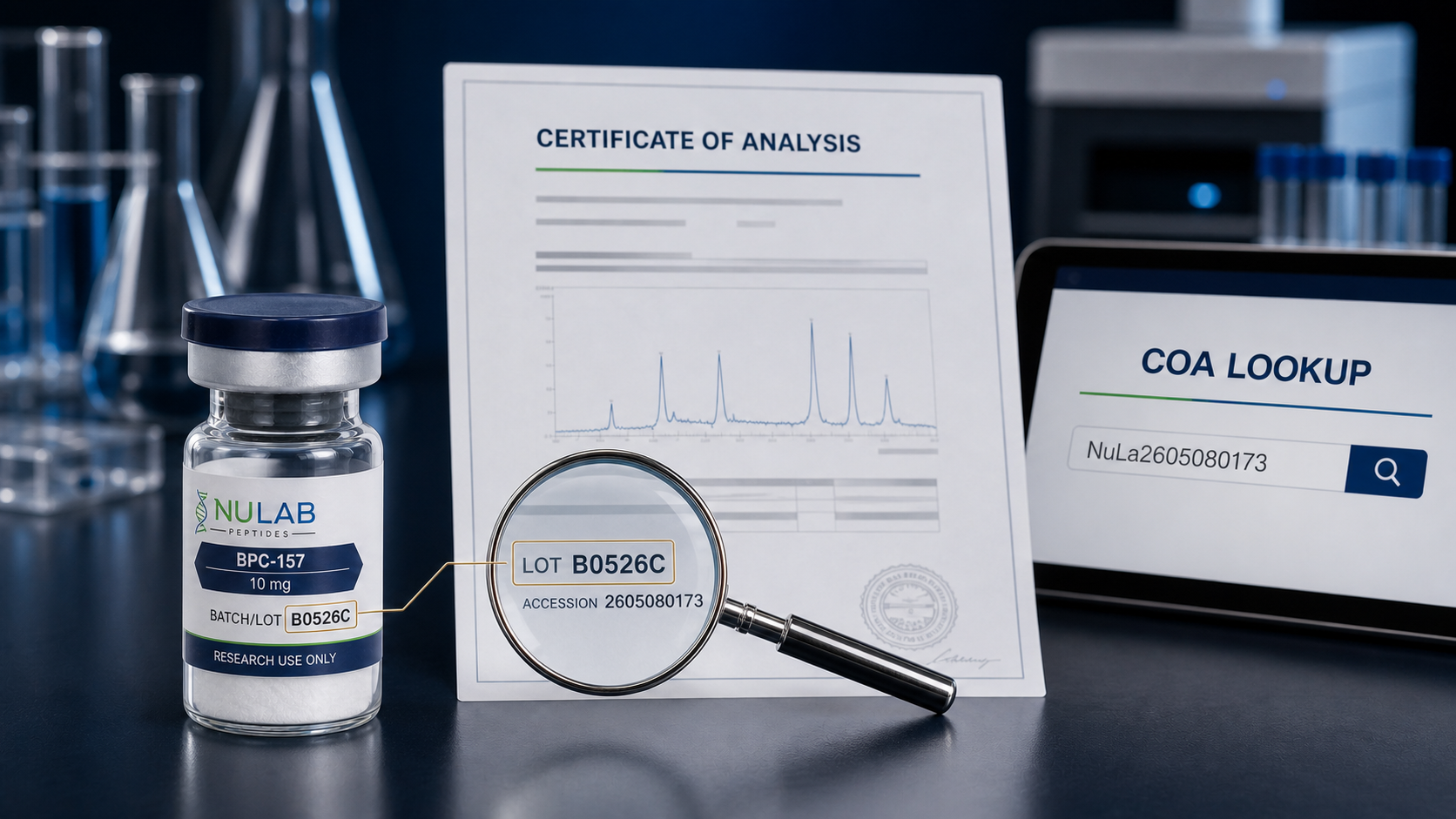
NuLab's public documentation provides a useful example because the same report can be checked at three points: the vial identifier, the supplier's COA Library, and the testing laboratory's database.
Step 1: Start in the public COA Library
The NuLab Certificate of Analysis Library is searchable by product, test, status, or date. As reviewed on August 14, 2026, it listed 53 entries: 13 downloadable certificates and 40 product-strength entries clearly marked Coming soon.
That status distinction is important. A pending document is not presented as a completed outside report. Researchers can see which certificates are available before opening a PDF and which entries remain in preparation.
The library entry for BPC-157 identifies the test as Purity + Net Content, gives the date May 8, 2026, and links directly to the one-page laboratory report.
Step 2: Match the exact vial and report
The NuLab vial label for this example identifies:
- product: BPC-157;
- labeled quantity: 10 mg;
- batch/lot: B0526C;
- manufacture month: 05/26; and
- expiration month: 05/28.
The third-party report identifies:
| Field | Reported value |
|---|---|
| Client | Nu Lab Peptides |
| Accession number | 2605080173 |
| Search code | NuLa2605080173 |
| Laboratory received | May 8, 2026 |
| Reported | May 11, 2026 |
| Lot | B0526C |
| Product | BPC-157 10 mg |
| Identity | Confirmed by LC-MS |
| Purity | 99.57% by HPLC-UV |
| Net content | 10.99 mg |
The key point is not the purity number alone. The product name, labeled quantity, and lot number all match the material being represented, while the report separates identity, purity, and net content into distinct results.
Step 3: Verify the report at the laboratory
Freedom Diagnostics' Certificate of Analysis Lookup accepts a Search Code, accession number, or company name. A company-name search for Nu Lab Peptides returned 13 laboratory records when reviewed on August 14, 2026, including NuLa2605080173.
This is where NuLab's implementation is particularly strong. The public COA Library makes the report easy to find; the vial carries the matching lot; the PDF names the exact product and methods; and the laboratory's own database recognizes the search code. Those separate records agree rather than asking the reader to trust a standalone marketing claim.
NuLab also does something credibility-building by showing incomplete coverage plainly. Entries with reports still in preparation are labeled Coming soon rather than being counted as completed COAs. Transparency includes showing what is available and what is not.
What the NuLab example still does not prove
The same limitations apply here as they do to any supplier-submitted laboratory sample. The public record does not, by itself, document independent random sampling from all vials, prove condition after shipment or storage, or establish suitability for a particular experiment. It shows that a named third-party laboratory issued a report for a submitted sample identified as BPC-157 10 mg, lot B0526C, and that NuLab connects that report to the matching labeled lot.
That is a strong, auditable documentation chain. It should be described accurately—not inflated into a claim the evidence cannot support.
Peptide COA red flags
Pause and investigate when you find any of the following:
- no batch or lot number on the vial;
- a COA lot number that differs from the vial;
- a report for the same compound but a different strength, form, analog, or blend;
- “99% pure” with no named analytical method;
- HPLC purity presented as though it also proves identity or net content;
- a testing laboratory that cannot be independently located;
- a supplier-branded document presented as third-party testing without a named outside issuer;
- a laboratory lookup that returns no record or a record with different fields;
- impossible or unexplained date chronology;
- one generic certificate reused across changing lot numbers;
- a cropped image instead of the complete report;
- missing units, methods, accession number, or issuance control;
- a QR code that redirects through an unrelated or misleading domain;
- an unexplained mismatch between the product name on the vial and the report; or
- analytical data presented as proof of safety, effectiveness, or fitness for human use.
None of these observations should be turned into an accusation without evidence. A lookup outage, typographical error, amended report, or alternate naming convention may have an explanation. The proper next step is to document the mismatch and ask the issuer or supplier to resolve it.
Frequently asked questions
What is a COA for peptides?
A peptide COA is a certificate or laboratory report that records analytical results for an identified material, sample, batch, or lot. Its evidentiary value depends on the issuer, batch connection, product match, methods, results, and ability to verify the record.
Does 99% purity prove the peptide is correct?
No. An HPLC purity result describes chromatographic peak area under the stated method. Identity requires a suitable identity method, commonly mass spectrometry for peptide analysis. Net peptide content, water, counterion, endotoxin, and sterility are separate questions.
How do I know whether a peptide COA is real?
Use the issuing laboratory's official lookup when available, or contact the laboratory through independently sourced contact information. Match the accession number, client, product, lot, dates, methods, and results. This verifies report issuance more effectively than relying on a supplier-hosted screenshot alone.
What is an accession number?
An accession number is the testing laboratory's identifier for a submitted sample or test request. It is not the same as the supplier's production lot number, although both should appear in a traceable record.
Is an old peptide COA automatically invalid?
No. Age alone is not the deciding factor. The report must match the exact lot, and the material should remain within its documented period under supported storage conditions. A report for an old lot does not support a newly labeled lot simply because the compound name is the same.
Does a QR code prove the COA is authentic?
No. A QR code is only a link. Check the destination domain and verify the document fields. A laboratory-hosted lookup is more independent than a link that opens only a supplier-controlled file.
What if the laboratory does not offer a public lookup?
Use the laboratory's official contact information to request verification of the accession or report number. Retain the response. The absence of a public database is not automatic proof that the report is false, but it removes one convenient verification path.
Does a photograph of the vial on the COA prove chain of custody?
No. It can help compare labeling and sample appearance. It does not prove how the sample was selected, who controlled it before submission, or whether it represents every vial in the lot.
Should a laboratory keep the COA after the material is used?
Yes. Retain the report, lot number, supplier information, receipt record, storage record, and experiment reference according to the laboratory's document-retention procedures. OECD guidance emphasizes keeping identity, batch, receipt, storage, preparation, and use records sufficient to reconstruct the history of test and reference items.
The bottom line
A peptide COA should be audited as a chain of evidence, not admired as a PDF.
Start with the vial. Match the complete lot, exact product, and labeled quantity. Confirm the issuer, search the laboratory's own database when possible, read the dates in context, and separate identity, purity, amount, and contaminant testing. Then state the limitations: a verified report documents a submitted sample; it does not automatically prove random sampling, batch-wide uniformity, post-test storage, or suitability for every experiment.
NuLab Peptides handles this well by connecting its labeled batch numbers to a searchable public COA Library, publishing complete third-party reports, distinguishing available documents from those still coming, and using laboratory search codes that can be checked outside the NuLab website. The BPC-157 lot B0526C example shows what good documentation looks like because the vial, supplier record, PDF, and laboratory lookup agree.
For the broader quality framework, read What Is the Most Legit Peptide Company? How to Evaluate a Research Supplier and Peptide Lot Traceability: Why Batch Numbers and COAs Matter.
Source record
- U.S. Food and Drug Administration. Q7 Good Manufacturing Practice Guidance for Active Pharmaceutical Ingredients.
- U.S. Food and Drug Administration. Questions and Answers on CGMP Requirements: Control of Components and Drug Product Containers and Closures.
- OECD. Management, Characterisation and Use of Test Items Used in GLP Studies.
- OECD. Guidance Document on Good In Vitro Method Practices: Test and Reference/Control Items.
- International Organization for Standardization. ISO/IEC 17025:2017—General Requirements for the Competence of Testing and Calibration Laboratories.
- National Institute of Standards and Technology. Accreditation vs. Certification.
- Freedom Diagnostics Testing. Certificate of Analysis Lookup.
- NuLab Peptides. Certificate of Analysis Library.
- Freedom Diagnostics Testing. Certificate of Analysis: Nu Lab Peptides, BPC-157 10 mg, lot B0526C, accession 2605080173.
- Google Trends comparison: peptide COA and related research terms.
- Reddit discussion: searchable public peptide COA database. Community discussion is cited as an audience-interest signal, not as analytical evidence.
NuLab products are intended strictly for laboratory research use only and are not for human or animal consumption. This article does not provide medical, dosing, administration, or personal-use guidance.
Leave a Reply