
Written by the NuLab Editorial Team · Published July 29, 2026 · Last reviewed July 29, 2026
A certificate of analysis is only useful when it can be connected to the specific batch in a researcher’s hands.
Quick answer: Peptide lot traceability is the documented connection between a research vial, its batch or lot number, and the batch-specific certificate of analysis. A traceable vial should carry an identifier that matches its COA, allowing the laboratory to connect the physical material to its analytical documentation.
In laboratory research, a vial should never exist as an unidentified container separated from its documentation. Researchers need to know which batch the material came from, when it was manufactured, the period during which it is expected to remain within its labeled specifications, and which analytical record applies to it.
That connection is lot traceability.
Traceability does not replace analytical testing, and a batch number alone does not prove identity or purity. But without a batch number, analytical results cannot be reliably connected to a particular vial. The label and the certificate of analysis must work tog
Learn more about NuLab research peptides and laboratory documentation.
What is lot traceability?
A lot—or batch—is a defined quantity of material produced through a particular process or series of processes. Its batch number is the unique identifier used to distinguish that material from every other batch.
The FDA-published ICH Q7 guidance defines a batch number as a unique combination of numbers, letters, or symbols that identifies a batch and allows its production and distribution history to be determined. The same guidance states that batch information should appear on a certificate of analysis and that an assigned expiration date should appear on the label and certificate.
OECD laboratory guidance applies the same underlying principle to research materials: records covering identity, batch number, purity, storage, preparation, and use should make it possible to reconstruct the history of a test or reference item.
The practical principle is straightforward: the identifier on the physical material must connect to the records describing that material.
Why batch-level identification matters
Peptide materials from two production lots may share the same name and nominal sequence while still having different production histories and analytical results. Treating them as interchangeable without retaining their batch identities creates avoidable uncertainty.
Lot traceability supports several essential laboratory functions:
Reproducibility
Recording the batch used in an experiment allows future work to distinguish a procedural difference from a potential lot-to-lot variable.
Document control
A lot-specific certificate of analysis can be matched to the material received. A generic report that cannot be connected to a batch does not provide the same evidentiary value.
Investigation
If a question arises, a batch identifier provides a defined starting point. Records, analytical results, inventory, and retained documentation can be reviewed against the same lot.
Inventory management
Manufacture and expiration information helps laboratories rotate inventory, document material status, and avoid using material outside its labeled period.
Accountability
Visible identifiers give purchasers and laboratory personnel a practical way to verify that the documentation supplied corresponds to the container in their possession.
The three identifiers NuLab places on every vial
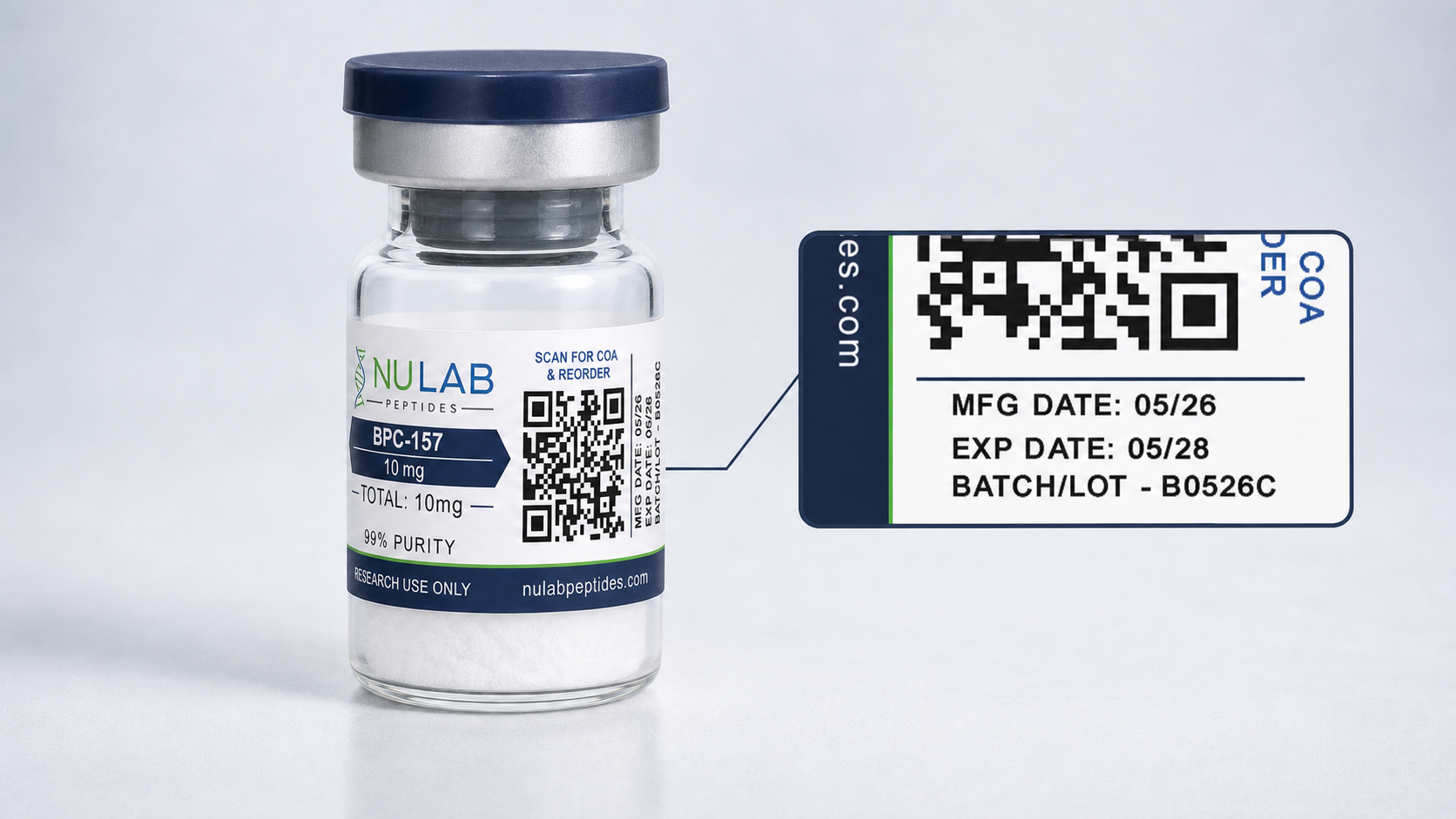
Every NuLab peptide vial displays:
- Manufacture month and year
- Expiration date
- Batch number
The batch number on the vial corresponds to the batch number on its certificate of analysis. Researchers can use that identifier to locate and review the applicable record in the NuLab COA Library.
Each field answers a different question:
- The manufacture month and year establishes when the batch was produced.
- The expiration date states the end of the labeled period during which the material is expected to remain within its established specifications when stored under the specified conditions.
- The batch number identifies the production lot and connects the vial to its analytical documentation.
Together, these identifiers create a visible line between the physical vial and the quality record associated with it.
| Label field | What it identifies | What to verify |
|---|---|---|
| Batch or lot number | The specific production batch | The identifier exactly matches the COA |
| Manufacture date | When the batch was produced | The date is recorded in laboratory inventory |
| Expiration date | The end of the labeled period | The material remains within its labeled period |
| COA identifier | The applicable analytical record | The document refers to the same material and batch |
A COA is only meaningful when it matches the vial
A certificate of analysis can report useful information about a batch, including the analytical methods used and the resulting identity or purity data. Its value depends on whether the laboratory can determine that the certificate actually applies to the material received.
That is why the batch number matters.
If a COA lists one batch number and the vial lists another, the document does not establish the test results for that vial. If the vial has no batch number at all, the connection cannot be verified. A polished certificate without a matching identifier is not a substitute for traceability.
NuLab’s standard is that the identifier travels with the material. The batch number printed on the vial is the same identifier used to locate its COA.
What traceability does—and does not—demonstrate
Traceability and analytical quality are related, but they are not identical.
A batch number does not, by itself, prove:
- peptide identity;
- purity;
- quantity;
- absence of impurities or contaminants; or
- suitability for a particular experimental method.
Those questions require appropriate specifications, analytical methods, results, and documentation.
What a batch number does demonstrate is that the material has been assigned an identity within a documentation system. It allows the relevant testing record to be connected to the vial. Without that connection, even legitimate analytical data may be impossible to attribute to the material in hand.
This distinction is important: traceability is not a replacement for testing. It is what makes batch-specific testing traceable.
Why NuLab considers anything less unacceptable
For NuLab, a peptide vial without a batch number, manufacture date, or expiration date falls below an acceptable quality standard. It leaves the researcher unable to answer basic questions about the material’s origin, age, labeled period, and supporting documentation.
The absence of those identifiers is not, by itself, chemical proof that a material is impure. It is proof of a traceability gap—and that gap is unacceptable under NuLab’s quality standard.
Researchers should not have to guess which certificate applies to a vial. They should not have to depend on a generic document that may represent a different production run. Essential identifying information should be visible on the material itself and verifiable against its supporting record.
That is why NuLab includes manufacture month and year, expiration date, and a COA-linked batch number on every vial.
A practical traceability check for laboratories
When receiving a research peptide, laboratory personnel can perform a simple documentation check:
- Confirm that the vial has a legible batch number.
- Locate the corresponding certificate of analysis.
- Verify that the batch number on the vial matches the batch number on the COA.
- Record the manufacture and expiration information in the laboratory’s inventory system.
- Retain the COA with the experiment or procurement records that reference the batch.
- Follow the labeled storage conditions and the laboratory’s applicable handling procedures.
This takes little time, but it preserves the connection between the material, the analytical record, and the work performed with it.
Traceability records which material was handled; environmental controls help preserve it. For a plain-language review of those controls, read Lyophilized Peptide Stability: Why Moisture, Temperature, and Light Matter.
Peptide lot traceability FAQs
Is a lot number the same as a batch number?
The terms are often used interchangeably, although an organization may define them differently within its own quality system. The practical requirement is that the identifier on the vial exactly matches the identifier on the applicable certificate of analysis.
How do I verify that a peptide COA matches a vial?
Compare the complete batch or lot number on the vial with the identifier on the COA. Also confirm that the material name and other identifying information are consistent. If the identifiers do not match, the COA does not establish the reported results for that vial.
Does a batch number prove peptide purity?
No. A batch number establishes traceability within a documentation system. Identity, purity, quantity, and other characteristics require appropriate analytical methods, specifications, results, and supporting records.
What should appear on a research peptide label?
Under NuLab’s quality standard, every vial displays its manufacture month and year, expiration date, and batch number. The batch number connects the vial to its batch-specific COA.
What does a missing lot number mean?
A missing lot number creates a traceability gap because the physical vial cannot be reliably connected to a batch-specific analytical record. It is not, by itself, chemical proof that the material is impure.
Quality information should follow the material
Lot traceability is one of the clearest visible signs of an organized quality system. It enables reproducibility, supports document control, and lets a laboratory verify which analytical results belong to which material.
NuLab’s position is simple: every vial should identify its batch, state when it was manufactured, show its expiration date, and connect directly to the appropriate certificate of analysis.
Anything less leaves an avoidable break in the record.
Review NuLab certificates of analysis in the COA Library.
For a broader supplier-evaluation framework, read What Is the Most Legit Peptide Company? How to Evaluate a Research Supplier.
References
- U.S. Food and Drug Administration, Q7 Good Manufacturing Practice Guidance for Active Pharmaceutical Ingredients.
- OECD, Guidance Document on Good In Vitro Method Practices: Test and Reference/Control Items.
- OECD, Management, Characterisation and Use of Test Items Used in GLP Studies.
The cited FDA/ICH and OECD materials are used as quality-management references for traceability principles. NuLab products are intended for laboratory research use only.
Leave a Reply