
Written by the NuLab Editorial Team · Published July 30, 2026 · Last reviewed July 30, 2026
A high purity number is useful, but it does not answer the most basic question: is the material actually BPC-157?
Quick answer: HPLC and LC-MS answer different questions about a peptide sample. HPLC separates the detectable components and estimates how much of the chromatogram belongs to the main component. LC-MS measures molecular mass and helps determine whether that main component matches BPC-157. A strong testing record uses the methods together rather than treating either one as a complete quality verdict.
In this guide
- What HPLC testing tells you
- What LC-MS testing tells you
- The plain-English HPLC vs. LC-MS comparison
- A real NuLab BPC-157 testing example
- BPC-157 testing FAQs
Peptide certificates of analysis often contain phrases such as “99% purity,” “HPLC tested,” or “identity confirmed by LC-MS.” Those phrases sound reassuring, but they do not all mean the same thing.
The easiest way to understand the difference is:
- HPLC asks: How clean does the sample look under this separation method?
- LC-MS asks: Does the main component have the molecular mass expected for BPC-157?
Those are related questions, but they are not interchangeable.
Why BPC-157 testing deserves a closer look
BPC-157 is a synthetic peptide made from a specific chain of 15 amino acids. The order of those amino acids matters. A sample with the wrong sequence, an incomplete sequence, or synthesis-related impurities may behave differently in laboratory work even if the vial carries the correct name.
According to PubChem, the BPC-157 free-base sequence is:
Gly-Glu-Pro-Pro-Pro-Gly-Lys-Pro-Ala-Asp-Asp-Ala-Gly-Leu-Val
In one-letter notation:
GEPPPGKPADDAGLV
PubChem reports an average molecular weight of approximately 1,419.5 grams per mole for the free-base form. That expected molecular weight gives a laboratory an important reference point when evaluating identity.
The chemical form should also be stated clearly. BPC-157 may be described as a free base or an acetate form. Those descriptions are not merely different labels; the counterion can affect the total composition and how analytical results are interpreted.
| BPC-157 reference fact | Plain-English meaning |
|---|---|
| 15 amino acids | The peptide contains 15 linked building blocks |
| Sequence: GEPPPGKPADDAGLV | The required order of those building blocks |
| Average molecular weight: about 1,419.5 g/mol | A reference value used during identity testing |
| Free base or acetate form | The reported chemical form should be identified |
What HPLC testing tells you
HPLC stands for high-performance liquid chromatography.
Imagine placing a mixture at the beginning of a very narrow course. Different components move through that course at different speeds. Some reach the finish sooner; others arrive later.
An HPLC system works on a similar principle. The dissolved sample moves through a packed column. Different components interact with the column and the liquid flowing through it in different ways, so they can separate from one another.
A detector records what exits the column and creates a chromatogram—a chart made of peaks.
- A large main peak usually represents the intended peptide.
- Smaller peaks may represent detectable impurities, degradation products, or other components.
- The time a component takes to reach the detector is its retention time; on the chromatogram, that determines the peak’s horizontal position.
When a COA reports 99.57% purity by HPLC-UV, that percentage commonly refers to the area of the main UV-detected peak compared with the total area of the included peaks under that test method.
That is valuable information. It suggests the chromatogram is dominated by one component.
But it does not automatically mean that 99.57% of everything in the vial, by weight, is BPC-157.
What an HPLC purity result does not prove
An HPLC purity percentage can be misunderstood because it looks like a complete score. It is not.
HPLC-UV alone does not necessarily establish:
- that the main peak is truly BPC-157;
- the exact amount of peptide in the vial;
- the amount of water or counterion present;
- whether two substances came out of the column together as one peak;
- the presence of something the selected detector does not see well;
- sterility, endotoxin levels, or microbial quality; or
- the complete structure of every impurity.
In other words, HPLC can show that one detected component dominates the chromatogram. Another method is needed to provide stronger evidence about what that component actually is.
What LC-MS testing tells you
LC-MS stands for liquid chromatography-mass spectrometry.
The first part—liquid chromatography—separates components. The second part—the mass spectrometer—examines the molecular mass of those components.
The mass spectrometer gives the molecules an electrical charge and measures their mass-to-charge ratio. Software can then use the resulting pattern to determine whether the observed mass agrees with the mass expected for BPC-157.
An easy analogy is:
- HPLC sorts the items into separate groups.
- Mass spectrometry weighs the molecules in the important group.
If the observed result agrees with the expected BPC-157 mass, that provides evidence supporting the material’s identity.
That match is strong evidence, but it is not magic. Different structures can occasionally have the same or a very similar mass. A laboratory can strengthen the conclusion with high-resolution measurements, fragmentation data, a qualified reference material, or another independent method.
This is why “identity confirmed by LC-MS” answers a different question from “99% pure by HPLC.”
Metal-binding peptides add another layer to that distinction. The Journal’s guide to GHK-Cu molecular structure and copper coordination explains why identifying a peptide and measuring copper do not, by themselves, establish the complex’s full solution structure.
HPLC and LC-MS are often part of the same test system
It is common to speak of “HPLC versus LC-MS,” but they are not always competing tests.
An LC-MS instrument uses liquid chromatography to separate the sample before the mass spectrometer evaluates it. A laboratory may also place a UV detector in the same analytical path.
That means one combined system can produce:
- an HPLC-UV chromatogram used to calculate a purity result; and
- a mass spectrum used to support an identity result.
This is how the current NuLab BPC-157 purity and net-content certificate describes its method: HPLC with UV detection coupled with mass spectrometry.
HPLC vs. LC-MS: the simple comparison
| Question | HPLC-UV | LC-MS |
|---|---|---|
| What is its main job? | Separate detectable components and estimate chromatographic purity | Measure mass-to-charge information and support molecular identity |
| What does the report usually show? | A chromatogram with peaks and a purity percentage | A mass spectrum with an observed molecular signal |
| Can it show that the sample is dominated by one detected component? | Yes | Not usually the primary purpose |
| Can it support that the main component matches BPC-157? | Only indirectly unless supported by a qualified reference and method | Yes, by comparing observed and expected mass |
| Does it prove the amount of peptide in the vial? | No | Not by identity testing alone |
| Does it establish sterility or endotoxin levels? | No | No |
A real NuLab BPC-157 testing example
In a batch-specific certificate dated May 11, 2026, Freedom Diagnostics reported three results for NuLab BPC-157:
| Test | Reported result | Question answered |
|---|---|---|
| Identity by LC-MS | BPC-157 confirmed | Does the molecular signal match BPC-157? |
| Purity by HPLC-UV | 99.57% | How much of the included chromatographic signal belongs to the main peak? |
| Net content | 10.99 mg | How much material was measured in the tested vial? |
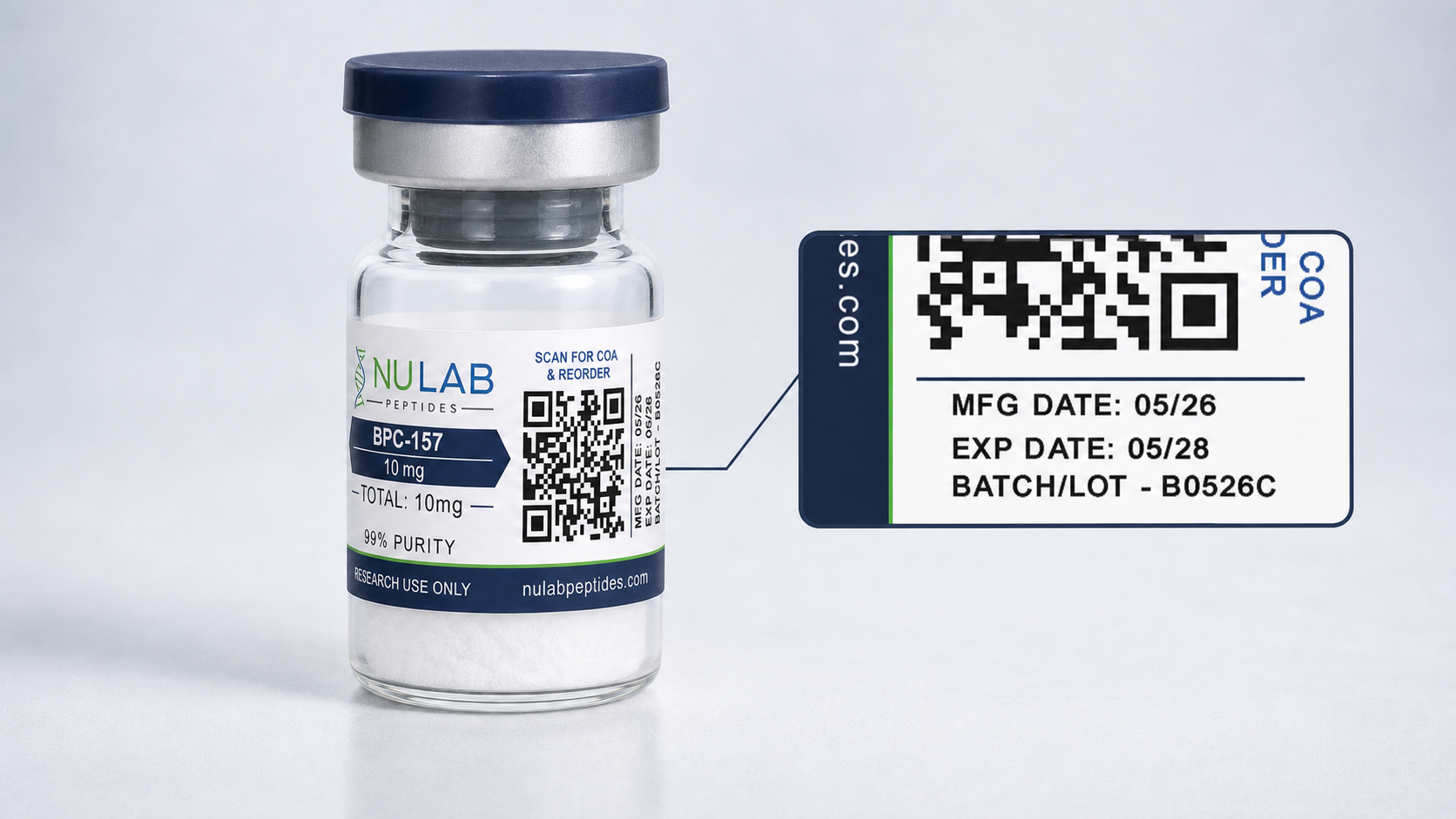
The certificate identifies the sample as lot B0526C. That lot number connects the analytical results to the corresponding NuLab vial.
This is important because the three reported results are not duplicates:
- Identity addresses what the main component is.
- Purity addresses the relative chromatographic profile.
- Net content addresses the amount measured in the vial.
The certificate can be reviewed in the NuLab COA Library.
For an explanation of why the lot number on the certificate must match the vial, read Peptide Lot Traceability: Why Batch Numbers and COAs Matter.
Why “lab tested” is not enough information
The phrase “lab tested” does not tell a researcher:
- which test was performed;
- what question the test was designed to answer;
- which batch was tested;
- which laboratory performed the work;
- when the sample was received and reported;
- what result was obtained; or
- whether the report applies to the vial in hand.
A useful COA should name the analytical method and report the result clearly. It should also identify the sample and batch so that the document can be matched to the physical material.
For BPC-157, a purity number without identity evidence leaves an unanswered question. An identity result without a chromatographic purity result leaves a different unanswered question.
What HPLC and LC-MS still do not cover
Even when both methods are used, they do not establish every possible quality characteristic.
Depending on the material, specification, and intended laboratory work, other testing may address:
- net peptide content;
- water content;
- residual solvents;
- counterion content;
- specified synthesis-related impurities;
- peptide aggregation;
- microbial limits;
- bacterial endotoxins; or
- stability over time.
In a 2026 BPC-157 briefing document, the FDA reported that most publicly available COAs it found contained only purity results. Those documents did not provide impurity limits or test results sufficient to demonstrate control of the full impurity profile.
That does not make HPLC or LC-MS unimportant. It means analytical methods should be interpreted according to the questions they can actually answer.
NuLab’s COA Library lists BPC-157 purity/net-content testing separately from its BPC-157 endotoxin report because those tests address different quality attributes.
A plain-English checklist for reviewing a BPC-157 COA
When reading a BPC-157 certificate, look for:
- A matching batch number. The identifier on the COA should match the vial.
- The chemical name and form. The document should state what material was evaluated.
- The identity method. Look for LC-MS, mass spectrometry, or another clearly stated identity method.
- The purity method. Look for HPLC-UV, UPLC, or another defined chromatographic method.
- The actual results. “Pass” is less informative than a clearly reported value and supporting chart.
- A chromatogram and mass spectrum. These provide supporting analytical context.
- The testing laboratory and dates. The certificate should identify who performed the work and when.
- A separate quantity result when quantity is claimed. Purity and net content are not the same measurement.
- Separate reports for separate quality questions. Identity and purity results do not replace endotoxin, microbial, or other applicable testing.
BPC-157 testing FAQs
Does 99% HPLC purity mean the vial is 99% BPC-157 by weight?
Not necessarily. It generally means the main peak accounted for approximately 99% of the included detector response under the HPLC method. Water, counterions, residual solvents, undetected components, and response differences can make total peptide content a separate question.
Can HPLC confirm that a sample is BPC-157?
HPLC can compare a sample’s retention behavior with a qualified reference under a defined method, but a purity chromatogram alone is not strong molecular-identity evidence. LC-MS adds mass information that directly supports identity.
Can LC-MS confirm BPC-157 purity?
LC-MS can help detect and identify components, but an identity result alone is not the same as a validated purity measurement. Chromatographic purity is commonly reported separately using HPLC-UV or a related method.
Why does a mass spectrum show a mass-to-charge value instead of 1,419.5?
Mass spectrometers evaluate electrically charged molecules. A peptide may carry more than one charge, so the instrument records mass divided by charge. The laboratory interprets that charge pattern to compare the observed molecule with the expected BPC-157 mass.
Does HPLC or LC-MS test for endotoxins?
No. Bacterial endotoxin testing is a separate analytical procedure. That is why NuLab publishes a separate endotoxin certificate for BPC-157.
Which test is more important?
They answer different questions. HPLC purity and LC-MS identity are most useful when read together and connected to the correct batch.
The bottom line
A BPC-157 testing report should do more than display a large purity percentage.
HPLC helps show how clean the sample appears under a defined chromatographic method. LC-MS helps confirm that the main component has the molecular mass expected for BPC-157. Net-content testing addresses the amount measured in the vial. Lot traceability connects all of those results to the physical material.
The clearest quality record does not ask one test to prove everything. It uses each method for the question it is designed to answer—and reports those results for an identifiable batch.
Review NuLab’s batch-specific testing documents in the COA Library.
References
- National Library of Medicine, PubChem, BPC-157 Compound Summary.
- U.S. Food and Drug Administration, 2026 Briefing Document for BPC-157-Related Bulk Drug Substances.
- McCarthy D, Han Y, Carrick K, et al., Reference Standards to Support Quality of Synthetic Peptide Therapeutics, Pharmaceutical Research 40, 1317-1328 (2023).
- John H, Walden M, Schäfer S, et al., Analytical Procedures for Quantification of Peptides in Pharmaceutical Research by Liquid Chromatography-Mass Spectrometry, Analytical and Bioanalytical Chemistry 378, 883-897 (2004).
- NuLab Peptides, BPC-157 Purity and Net Content Certificate.
NuLab products are intended strictly for laboratory research use only and are not for human or animal consumption. This article explains analytical testing and does not provide medical, dosing, or administration guidance.
Leave a Reply