
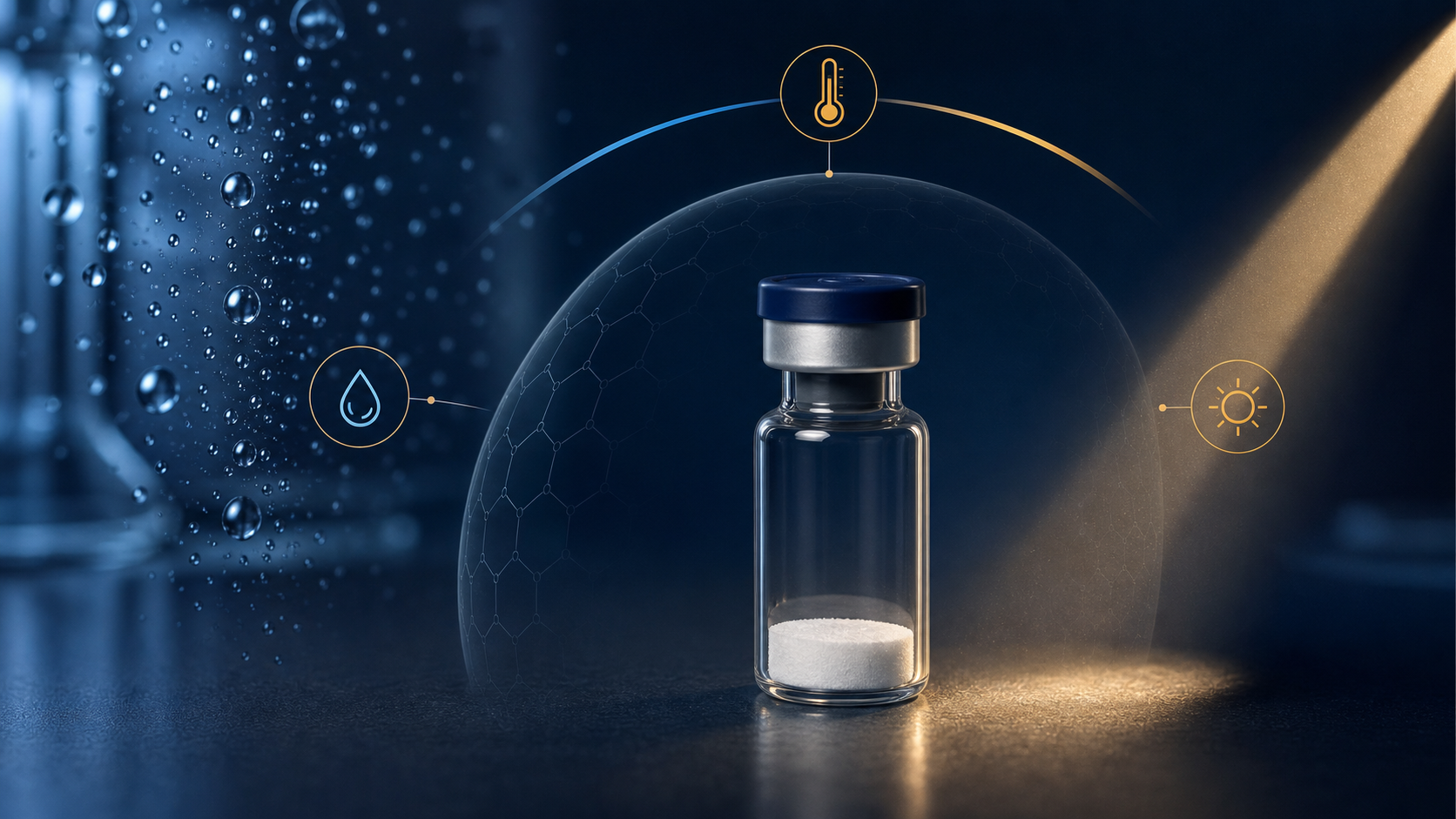
Written by the NuLab Editorial Team · Published July 30, 2026 · Last reviewed July 30, 2026
Lyophilization can improve peptide stability by removing most of the water from a sample. It does not make the material indestructible.
Residual moisture, condensation, temperature changes, light exposure, and the peptide's amino-acid sequence can still affect a lyophilized research sample. Good laboratory storage therefore requires more than placing a vial in a freezer and forgetting about it.
Quick answer: Keep lyophilized research peptides sealed, dry, protected from light, and at the product-specific storage temperature. Before opening a cold vial, allow the sealed container to reach room temperature in a dry environment. This helps prevent condensation from forming inside.
In this guide
- What lyophilized actually means
- Why moisture matters
- The cold-vial condensation problem
- Why temperature matters
- Why light matters
- How the amino-acid sequence changes the risk
- A practical laboratory storage checklist
- How NuLab supports storage traceability
- Lyophilized peptide stability FAQs
What lyophilized actually means
Lyophilization is commonly called freeze-drying. During the process, a frozen sample is placed under reduced pressure so that ice can leave the material as vapor.
The resulting solid may look completely dry, but it is not necessarily free of water. Small amounts of residual moisture can remain after processing. The amount depends on the peptide, formulation, equipment, drying cycle, vial, and closure system.
Removing most of the water generally slows molecular movement and reduces the opportunity for certain degradation reactions. It does not stop every reaction, and it does not guarantee unlimited stability.
A lyophilized vial should therefore be treated as a moisture-sensitive laboratory material—not as an inert powder.
Why moisture matters
Moisture can enter a vial through prolonged exposure to humid air, an imperfect closure, or condensation during handling.
Once absorbed, water can increase molecular movement within the dried material. In plain language, the peptide and other components become less "locked in place." This can make physical and chemical changes more likely.
A laboratory study of the lyophilized peptide CSP7 found that exposure to high relative humidity increased absorbed moisture, affected the formulation's physical structure, and produced reversible peptide aggregation. The result was formulation-dependent, illustrating why moisture risk cannot be evaluated from the word "lyophilized" alone. Read the CSP7 stability study in PubMed Central.
Residual moisture is also different from HPLC purity. HPLC can describe how much of a chromatogram is associated with the principal component, but it does not automatically report the amount of water in a dried sample. Residual water is commonly evaluated using a moisture-specific method such as Karl Fischer titration.
For a plain-English explanation of chromatographic purity and molecular identity, read BPC-157 Testing Explained: HPLC vs. LC-MS.
The cold-vial condensation problem
One of the easiest storage mistakes occurs when a cold vial is opened immediately after removal from refrigerated or frozen storage.
Warm laboratory air can contain considerably more water vapor than cold air. When that air contacts a cold vial or cold material, some of the vapor may condense into liquid water—the same process that causes moisture to appear on the outside of a cold drink.
If the vial is already open, that condensation can occur where it matters most: inside the container.
AAPPTEC, Bachem, and MilliporeSigma each advise allowing a cold peptide container to reach room temperature before opening it. Bachem specifically recommends equilibration in a desiccator because many peptides are hygroscopic, meaning they readily absorb moisture from the atmosphere.
The important sequence is simple:
- Remove the sealed vial from cold storage.
- Keep it sealed while it reaches the laboratory's working temperature.
- Use a dry environment or desiccator when required by the laboratory protocol.
- Open the vial only after equilibration.
- Minimize the time the vial remains open and reseal it promptly.
Why temperature matters
Lower storage temperatures generally slow chemical reactions, but there is no universal temperature that applies equally to every peptide and every formulation.
Supplier recommendations vary. AAPPTEC recommends protection from heat, light, and moisture, with colder conditions for longer storage. Bachem also emphasizes storage as a tightly closed lyophilizate and notes that stability can depend on amino-acid composition. The product label and lot-specific documentation should take priority over generalized internet advice.
Temperature excursions should be evaluated using both time and temperature. A short deviation is not automatically proof that a sample has failed. Likewise, a vial that looks normal is not automatically proof that nothing changed.
When an excursion occurs, the laboratory should document:
- the affected product and batch number;
- the normal storage range;
- the highest or lowest observed temperature;
- the estimated duration;
- whether the vial remained sealed;
- whether light or moisture exposure also occurred; and
- the basis for returning the material to service, quarantining it, or testing it.
Research on freeze-dried materials has shown that temperature, residual moisture, oxygen, and formulation can interact. That makes an undocumented guess less defensible than a recorded, lot-specific evaluation. Review the freeze-dried stability study indexed by PubMed.
Why light matters
Light can supply the energy needed for certain chemical reactions. Direct sunlight and ultraviolet exposure are usually the greatest concerns, but prolonged exposure to strong laboratory lighting may also be relevant for a light-sensitive sequence.
Thermo Fisher Scientific advises protecting many research peptides from direct light. Review Thermo Fisher's peptide handling instructions.
Practical laboratory controls can include:
- keeping the material in its original protective packaging;
- using appropriate secondary containers;
- limiting unnecessary time under direct lighting;
- avoiding storage near windows or heat-producing lamps; and
- recording unusual exposure as part of the sample history.
Protecting a vial from light does not require assuming that every peptide reacts identically. It recognizes that the risk may be sequence-dependent and that unnecessary exposure provides no analytical benefit.
How the amino-acid sequence changes the risk
"Peptide stability" is not a single property shared equally by every peptide. The sequence influences which degradation pathways may be possible and how quickly they may occur.
| Sequence feature | Potential concern |
|---|---|
| Cysteine, methionine, or tryptophan | Greater attention to oxidation |
| Asparagine or glutamine | Possible deamidation under susceptible conditions |
| Certain aspartic-acid sequences | Isomerization or cleavage may be possible |
| Free cysteine residues | Oxidation or disulfide-related changes |
| Highly hydrophobic sequences | Greater aggregation or surface-adsorption concerns |
These are susceptibility indicators—not proof that degradation has occurred. Temperature, water, oxygen, light, pH, formulation, neighboring residues, and storage duration all influence the outcome.
This is why stability cannot be determined from the peptide name alone.
A practical laboratory storage checklist
For unopened lyophilized research material:
- Confirm the product, batch number, manufacture date, and expiration date.
- Review the product-specific label and storage documentation.
- Record receipt conditions when required by the laboratory's quality system.
- Place the material into its designated storage environment promptly.
- Keep the vial sealed and protected from moisture and direct light.
- Avoid unnecessary temperature cycling.
- Allow a cold, sealed vial to equilibrate before opening.
- Minimize open-container time.
- Record temperature, moisture, or light excursions.
- Use appropriate analytical testing when storage integrity is uncertain.
This checklist concerns laboratory material control only. It is not a reconstitution protocol and does not replace product-specific instructions.
How NuLab supports storage traceability
Every NuLab research vial includes three important pieces of information:
- manufacture month and year;
- expiration date; and
- batch number.
The batch number corresponds to the product's certificate of analysis. This creates a documented connection between the physical vial, its manufacturing lot, and the analytical report associated with that lot.
Storage practices and analytical documentation serve different purposes. A COA records testing performed on a batch. Proper storage helps protect the material after that testing. Lot traceability allows the laboratory to connect both sides of the record.
Learn more in Peptide Lot Traceability: Why Batch Numbers and COAs Matter or search current reports in the NuLab COA Library.
Lyophilized peptide stability FAQs
Is a lyophilized peptide completely dry?
Not necessarily. Lyophilization removes most water, but residual moisture may remain. The amount cannot be determined from appearance alone.
Why should a cold vial remain sealed while warming?
Keeping it sealed reduces contact between the cold material and humid laboratory air. This helps prevent condensation inside the vial.
Does one temperature excursion mean the material has failed?
Not automatically. Risk depends on the temperature, duration, sequence, formulation, packaging, and other exposures. The excursion should be documented and evaluated against appropriate stability information.
Can degradation always be seen?
No. A vial can appear unchanged while its chemical profile has shifted. Visual inspection is useful, but it is not a substitute for analytical testing.
Are all lyophilized peptides stored the same way?
No. General principles are helpful, but the product label and supplier's product-specific guidance should control the laboratory protocol.
The bottom line
Lyophilization improves stability by removing most of the water that supports molecular movement and degradation. It does not eliminate the effects of humidity, condensation, temperature, light, oxygen, or sequence chemistry.
The strongest laboratory practice is straightforward: keep the vial sealed, dry, protected, correctly labeled, and stored according to its product-specific documentation. When an excursion occurs, record it and evaluate it rather than relying on appearance or assumption.
References
- AAPPTEC: Handling and Storage of Peptides
- Bachem: Handling and Storage Guidelines for Peptides
- MilliporeSigma: Storage and Handling of Synthetic Peptides
- Thermo Fisher Scientific: Handling and Storage Instructions for Custom Peptides
- Surasarang et al.: Formulation for a Novel Inhaled Peptide Therapeutic
- Pikal, Dellerman, and Roy: Effects of Moisture and Oxygen on Freeze-Dried Formulations
NuLab products are intended strictly for laboratory research use only and are not for human or animal consumption. This article does not provide medical, dosing, or administration guidance.
Leave a Reply